
Children and adolescents today are involved in more than just playing video games. They are part of online communities, communicate with others about games, and are members of various video gaming subcultures. Gaming culture can be very diverse and not everyone is automatically interested in all aspects of it. This section explains some of the most important terms and formats you may encounter if your child is into gaming.
Online communities and fandoms
As in other areas of pop culture, gamers form online communities focused on the specific trends, games, or personalities they like most. These communities, also known as “fandoms,” are very important to teens because it is through them that they make new friends and develop their identity. Popular “meeting places” for these groups include social platforms like Discord and Twitch, websites like Reddit, or forums set up by the various game creators.
Tip
Communities and fandoms are sustained by members communicating and staying engaged. For young people, actively participating in such communities is an important part of their personal development. To learn how you can make participation as safe as possible, see here.
Gaming influencers
Influencers are people who use their popularity on social media, such as Instagram, TikTok, or YouTube, to earn a living. They reach a large number of people by creating and sharing entertaining or engaging content. Teens and young adults often view influencers as role models. Influencers can be as influential as music or movie stars.
Gaming influencers post social media content about video games that reaches a very large audience. For example, they create videos in which they introduce games, share tips and tricks, or live-steam their own video gaming sessions. They attract a large community of fans who are interested in new games and everything relating to games. Influencers earn money through advertising built into their content or through funding from individual subscribers.
Tip
Ask your child why they follow certain influencers and what exactly makes the content and videos so engaging. This will give you better insight into your child’s interests and role models.
Let’s Plays and livestreaming
In a Let’s Play video, viewers can watch someone while they play a game and comment on various aspects of it. Usually this involves enhancing the action of the game with humorous or exciting commentary. The videos are uploaded to platforms like YouTube. Another type of Let’s Play is livestreamed, for example on the platform Twitch.
In a Let’s Play, the viewer sometimes only hears the voice of the person playing, while only the game is visible in the video. Other times, a small video feed of the gamer is also shown. The main purpose is to experience the gamer’s reactions. A lot of times, viewers consider Let’s Plays more important than the game itself. Videos of this type are especially popular because gaming influencers can chat with their followers during a livestream Let’s Play.
Tip
Keep an eye not only on which games your child is playing, but also on the game content they might be viewing in online videos. USK age ratings are not given for video recordings of a game, but they can still serve as a guideline.
Cosplay
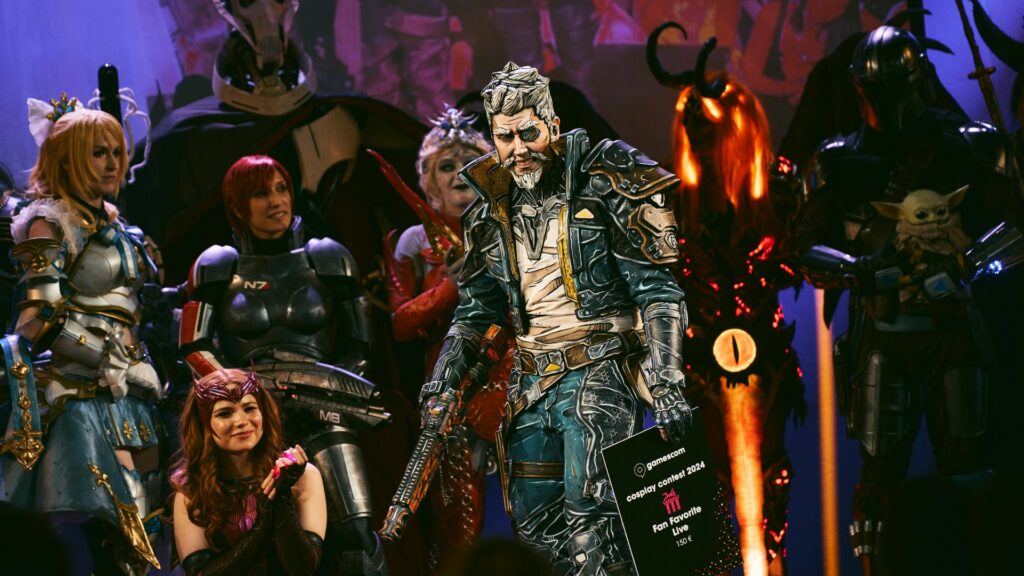
Cosplay (short for “costume play”) refers to people who roleplay characters from computer games or other media. They wear costumes and imitate the characters’ behavior. Cosplay has its origins in the Japanese manga and anime fan culture. Costumes often include accessories like jewelry, fake weapons, and other objects. Special makeup and wigs are also used to recreate a character’s appearance as accurately as possible.
Cosplay is usually for fun or for competitions at conventions. Only a few cosplayers earn money by being hired to make professional appearances.
Tip
Cosplay is more than just a hobby. Participants learn numerous manual skills through the crafting, designing, sewing, and tailoring that is involved. Encourage your child to get creative and learn new skills.
Esports
Esports refers to athletic competition with video games. Any video game can be played as an esport if set rules defined by an esport organization are followed. In practice, specific multiplayer games are primarily played in large-scale competitions.
As in other forms of sport, fast reaction speeds, team spirit, motivation, and fairness are what count in esport. Esport professionals are committed to physical and mental fitness as well as a healthy diet. Apart from professional esports, with sponsored teams and championships viewed by millions of fans, there is also a thriving hobby and amateur scene with organized clubs.
Tip
Through esports, young people can make new friends and experience team play. In other words, esport is not like “playing by yourself on a computer”; it can strengthen the social skills of adolescents.
Gaming as an opportunity for the future
Video and computer games are a free time activity, a break from the daily routine – and this is precisely what makes gaming so attractive. That does not mean, however, that gaming is a waste of time. In addition to being entertaining, games give children and adolescents an opportunity to get active or creative. Whether young people moderate an online forum or develop their own games in their free time: Parents should support these interests just like they would other social or creative activities such as learning an instrument, drawing, or writing.
People who develop their own computer games acquire design and technical skills that are important in many occupations. Programming, graphic and interface design, and the use of AI systems are just a few examples. Learning all you can about video games promotes an understanding of the medium’s impact and strengthens the media competence of young people. What is more, some computer games help with better understanding complex subjects like history, politics, and economics.
Tip
Does your child like to work on developing their own computer games? Have them show you the results and how they got there. You may discover that your child has new talents.


